A sudden cardiac arrest can happen to anyone, anywhere and at any time. It could happen at work, in the gym, at a local community event or in the home. In fact, 80% of out-of-hospital cardiac arrests happen at home.
When it does, every minute matters. Knowing where to find a public access defibrillator and having the confidence to use one could make the difference between life and death.
But despite more defibrillators appearing in our communities, many people are still unsure what they are, how they work or whether they are allowed to use one.
There have also been some important updates to defibrillator guidance, particularly concerning pad positioning, which is definitely worth knowing about.
What is a public access defibrillator?
A public access defibrillator (PAD), also known as an automated external defibrillator (AED), is a portable device designed to help someone experiencing a cardiac arrest.
During a cardiac arrest, the heart stops pumping blood effectively around the body. A defibrillator analyses the heart’s electrical rhythm and, if appropriate, delivers an electric shock to help restore a potentially life-sustaining rhythm.
You will often find public access defibrillators in green or yellow cabinets outside community buildings, schools, village halls, sports facilities, railway stations and other public spaces.
They are designed to be used by members of the public, not just trained first aiders.
Do I need training to use a defibrillator?
This is one of the biggest misconceptions surrounding public access defibrillators.
No, you do not need any previous training or medical knowledge to use one.
Defibrillators are designed to be straightforward to operate. Once switched on, the device provides clear spoken and sometimes visual instructions, guiding you through each step.
It will analyse the person’s heart rhythm and will only advise or deliver a shock if one is needed. You cannot accidentally deliver a shock to someone whose heart rhythm does not require one.
There really is no reason to be afraid of using one. Following the instructions could help save someone’s life.
Updated guidance: Where should defibrillator pads be positioned?
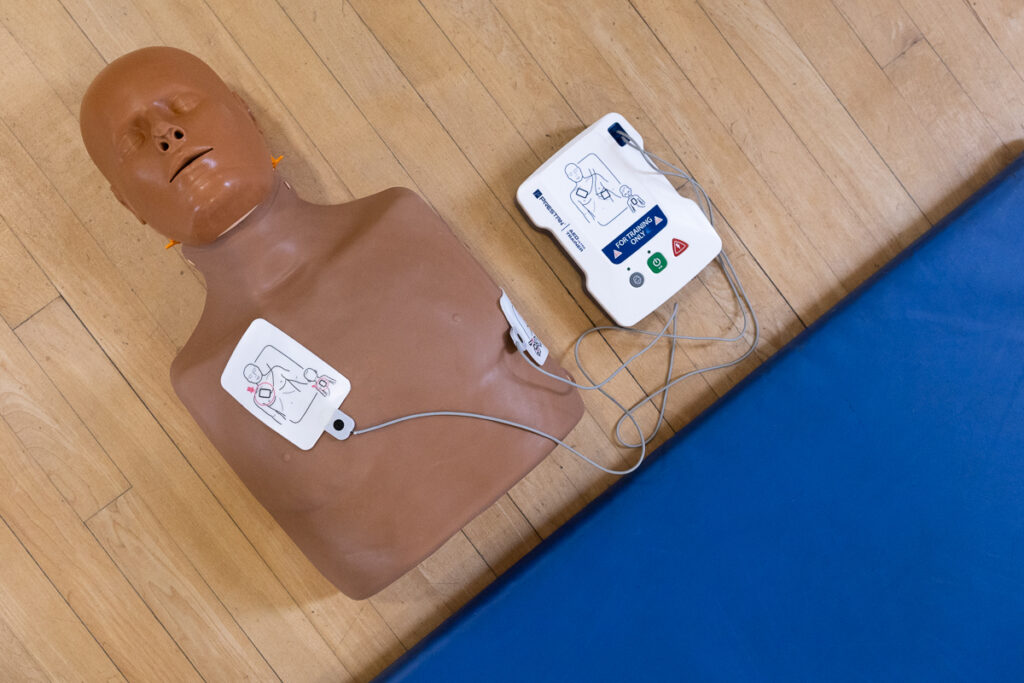
The Resuscitation Council UK’s 2025 Resuscitation Guidelines provide updated guidance on defibrillator pad positioning.
For adults, the recommended anterolateral position involves placing:
- The first pad: On the upper right side of the chest, just below the collarbone.
- The second pad: On the left side of the chest, directly below the armpit, with the centre of the pad positioned along the mid-axillary line (the imaginary line running down the side of the body from the middle of the armpit).
This means the second pad now sits slightly higher up on the body, directly under the armpit, which research has shown to increase the chance of effectiveness.
The illustrations may not have been updated but it is an important detail to get right, as correct positioning helps ensure the electrical current passes through the heart.
What about using a defibrillator on a woman?
There can sometimes be hesitation about exposing a woman’s chest to apply defibrillator pads, but it is important that this does not delay life-saving treatment.
Pads must be applied to bare skin and positioned correctly, avoiding breast tissue. A bra does not necessarily need to be completely removed if it can be moved out of the way quickly enough to allow correct pad placement and good skin contact. However, if it interferes with positioning, it should be removed.
The priority is always to get the pads into the correct position and follow the defibrillator’s instructions.
What should I do if someone collapses?
If someone suddenly collapses and is unresponsive and not breathing normally, assume they are in cardiac arrest.
Here’s what to do:
- Check for a response. Make sure the area is safe, gently shake their shoulders and shout to see if they respond.
- Call 999. Ask for an ambulance and put your phone on loudspeaker. The emergency call handler will guide you through what to do and can help locate your nearest accessible defibrillator.
- Start CPR. Begin chest compressions as soon as possible. Push hard and fast in the centre of the chest, aiming for 100 to 120 compressions per minute. If you are trained and willing, give rescue breaths as well. You can learn more about delivering effective CPR here Your Guide to CPR – Adult and Paediatric (Updated for the 2025 Resuscitation Council UK Guidelines) | First Class First Aid
- Get a defibrillator. If someone else is present, ask them to find and bring the nearest AED. Do not leave the casualty if you are on your own. Continue CPR and wait for the ambulance to arrive.
- Switch on the defibrillator and follow the instructions. Attach the pads to the person’s bare chest as shown on the device. The pads may be readily visible, or in a pouch or pocket. Make sure nobody touches the person while the machine analyses their heart rhythm or delivers a shock.
- Continue CPR. Follow the defibrillator’s instructions, restarting chest compressions immediately when instructed. Continue until emergency services arrive, the person shows signs of life and is breathing normally, or you are unable to continue.
Remember, early CPR and defibrillation give someone the best possible chance of survival.
Where can I find my nearest defibrillator?
You might be surprised by how many defibrillators are already available in your local community.
The British Heart Foundation, alongside Resuscitation Council UK and ambulance services, supports The Circuit – the national defibrillator network, the national defibrillator network.
You can use the Defib Finder to search for registered public access defibrillators near you.
It is worth familiarising yourself with the locations of your nearest devices before an emergency happens. Knowing where to find one could save valuable time.
When you call 999, the ambulance call handler can also direct you to the nearest registered and accessible defibrillator.
Why is registering and maintaining a defibrillator important?
Having a defibrillator available is fantastic, but it is equally important to make sure it is ready to use when needed.
Organisations and community groups that own a defibrillator should ensure it is registered on The Circuit. This allows ambulance services to identify its location and direct members of the public to it during an emergency.
Regular checks are also essential. Batteries and electrode pads have expiry dates, and a device that is not maintained properly may not be ready when someone needs it. The Circuit will help with this by sending reminders on the upkeep of your defibrillator.
Could you make a difference?
A sudden cardiac arrest is frightening, and it is understandable that people might worry about doing the wrong thing.
But remember, you do not need to be a medical professional or a trained first aider to use a public access defibrillator. You simply need to be willing to act and follow the instructions provided.
Learning CPR and how to use a defibrillator can give you the confidence to respond in an emergency. It is also an important part of workplace first aid training, helping people understand what to do when someone suffers a cardiac arrest.
At First Class First Aid, I believe everyone should have the opportunity to learn skills that could save a life. You never know when you might need them.
Take a moment to find your nearest defibrillator. It could be the most important thing you do today.