When someone has a cardiac arrest, every second counts. Starting CPR immediately can more than double a person’s chance of survival. I’ve published a CPR guide before but as we’ve had a number of changes this year, I thought it was time to publish an update.
The 2025 Resuscitation Council UK (RCUK) updates reinforced existing CPR principles while introducing a few important refinements across adult and paediatric resuscitation. The focus remains on simplicity, speed, and high-quality CPR.
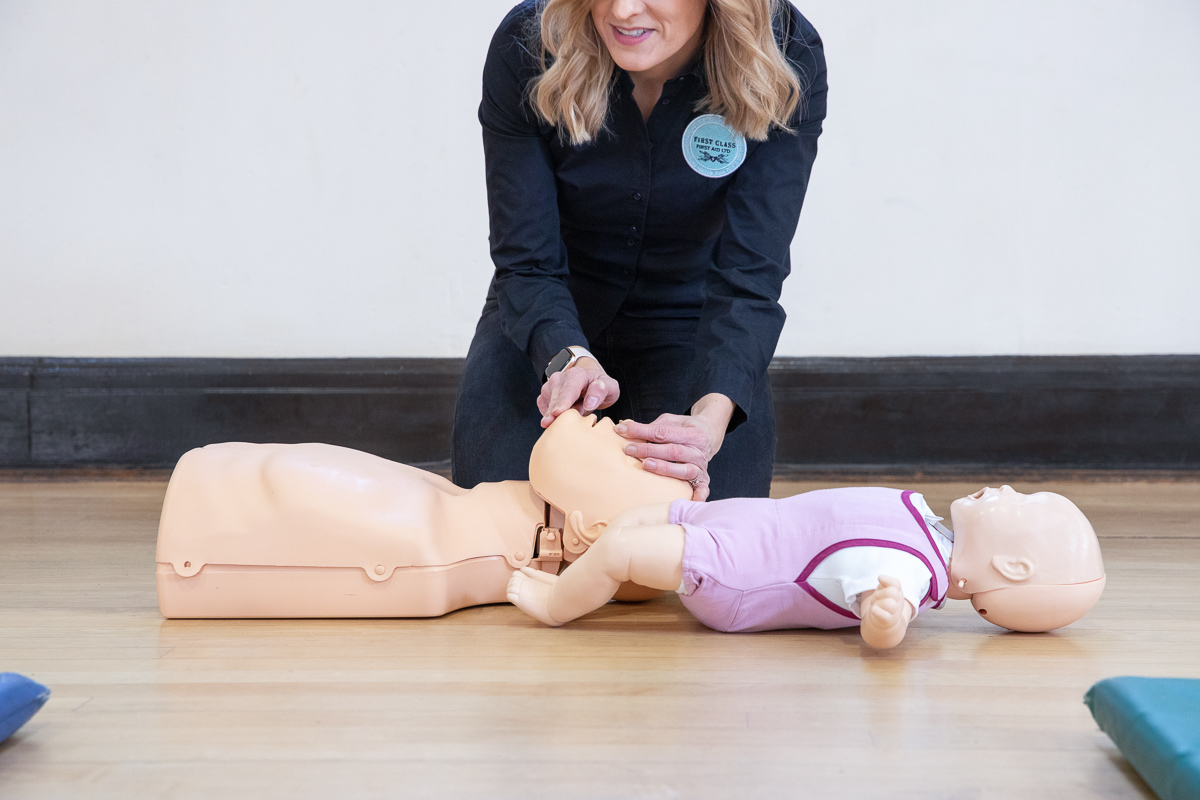
At First Class First Aid, I teach practical, hands-on CPR using the latest 2025 Resuscitation Council UK (RCUK) guidelines, helping learners feel prepared to step in during an emergency.
What is CPR?
Cardiopulmonary Resuscitation, commonly known as CPR, is an emergency procedure that helps maintain blood flow and oxygenation to vital organs during cardiac arrest (when someone’s heart suddenly stops beating effectively).
By performing CPR, you’re buying time for professional medical assistance to arrive, or until a defibrillator (AED) can be used, increasing the chances of the person’s survival.
Adult CPR
The adult basic life support sequence remains the foundation of CPR, with a continued emphasis on early action and minimal delay. You can read about the updated primary survey; DRC ABCDE here: From DR ABC to DR C ABCDE – What First Aiders Need to Know | First Class First Aid
1. Check for danger
Ensure the area is safe for you, the casualty, and any bystanders.
2. Check response
Gently shake their shoulders and shout: “Are you ok?”
3. Call 999 immediately
- Call straight away for any unresponsive person
- Put the phone on loudspeaker if possible
- Send someone to get an AED (call handler will advise if there is one nearby)
4. Check breathing
For up to 10 seconds, look, listen and feel for normal breathing.
If they are not breathing normally (or are only gasping), treat as cardiac arrest.
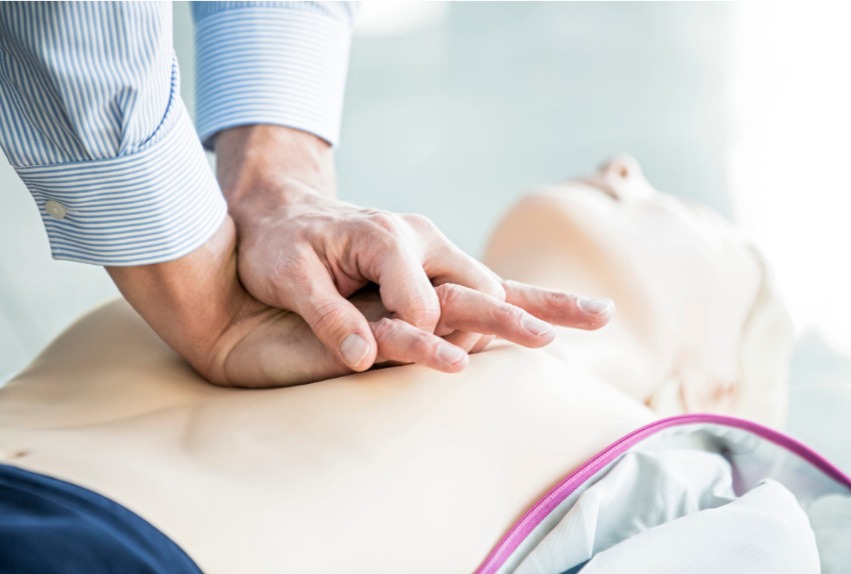
5. Position Your Hands
- Place the heel of one hand in the centre of the chest.
- Place your other hand on top.
- Interlock your fingers.
- Keep your arms straight with your shoulders directly above your hands.
6. Give Chest Compressions
Compress the chest:
- 5–6 cm deep
- At a rate of 100–120 compressions per minute
- Allow the chest to fully recoil after each compression.
Aim to minimise interruptions.
7. Give Rescue Breaths if trained to do so
After 30 compressions:
- Open the airway with a head tilt and chin lift.
- Pinch the nose closed.
- Give 2 rescue breaths, each lasting about one second.
- Watch for the chest to rise.
Continue with:
30 compressions : 2 rescue breaths
If you are unwilling or unable to give rescue breaths, hands-only CPR is far better than doing nothing.
8. Continue Until Help Arrives
Continue CPR until:
- The casualty starts breathing normally.
- An AED instructs you to stop.
- Emergency services take over.
- You become physically unable to continue.
Using an AED (Automated External Defibrillator)
Early defibrillation is one of the most important links in the Chain of Survival. An AED is designed to be used by anyone and gives clear voice prompts throughout.
Using an AED
- Turn the AED on immediately.
- Follow the voice and visual instructions.
- Expose the chest and dry it if necessary.
- Attach the pads exactly as shown on the diagrams.
- Ensure nobody is touching the casualty while the AED analyses the heart rhythm or delivers a shock.
- Resume CPR immediately when instructed.
Pad Placement
For adults, place:
- One pad just below the right collarbone.
- The second pad on the left side of the chest, below the armpit.
For children, follow the diagrams on the pads.
If the child’s chest is too small and the pads may touch, place:
- One pad on the centre of the chest.
- One pad on the back between the shoulder blades.
This front-and-back (antero-posterior) placement helps ensure the electrical current passes safely through the heart.
Different Types of AED
You may encounter:
- Fully automatic AEDs
- Semi-automatic AEDs
- AEDs with a paediatric mode
- AEDs supplied with paediatric pads
Although the devices may look different, they all work in the same way. Pads may be stored in a pocket and not immediately visible.
Turn it on and follow the prompts.
If paediatric pads or a paediatric mode aren’t available, do not delay treatment. Use the standard adult pads and position them so they do not overlap.
Paediatric Changes in the 2025 Resuscitation Council UK Guidelines
While the adult CPR sequence remains largely unchanged, the 2025 guidance includes some important updates for babies and children.
Children are more likely to experience cardiac arrest because of a breathing problem, making rescue breaths particularly important.
Initial Rescue Breaths
Children and infants should still receive:
5 initial rescue breaths
before chest compressions are started.
Children (1 Year to 18 Years)
Compression Ratios
If you are trained in paediatric first aid:
15 compressions : 2 rescue breaths
If you are only trained in adult CPR or are an untrained bystander:
30 compressions : 2 rescue breaths
The priority is always to begin CPR immediately.
Chest Compression Technique
Hand position should be adapted to the size of the child.
Smaller children (approximately under 8 years)
A one-hand technique is often appropriate.
- Place one hand in the centre of the chest.
- Compress to approximately one-third of the chest depth.
- Maintain a rate of 100–120 compressions per minute.
Older or larger children
Use two hands if this is needed to achieve effective chest compressions to approximately one-third of the chest depth.
The aim is always to provide high-quality compressions while adapting your technique to the child’s size.
Infants (Under 1 Year)
The preferred technique for infant chest compressions is now the two-thumb encircling technique.
- Place both thumbs on the lower half of the breastbone.
- Wrap your fingers around the baby’s chest to support their back.
- Compress the chest by approximately one-third of its depth.
- Compress at 100–120 per minute.
Infant Compression Ratios
Paediatric trained:
15 compressions : 2 rescue breaths
Adult-trained or untrained:
30 compressions : 2 rescue breaths
What’s Changed in the 2025 Guidelines?
The latest guidance introduces these important updates:
✅ The DR CABCDE approach now includes checking for Catastrophic Bleeding before airway management. You can read more here: From DR ABC to DR C ABCDE – What First Aiders Need to Know | First Class First Aid
✅ The two-thumb encircling technique is now the preferred method for infant chest compressions.
✅ Rescuers trained in paediatric first aid should use a 15:2 compression-to-breath ratio for children and infants.
Learn CPR with Confidence
At First Class First Aid, our courses are friendly, hands-on and designed to give you the knowledge and confidence to act in a real emergency. You’ll practise on realistic training equipment, learn the latest Resuscitation Council UK guidance and leave knowing you have the skills to make a real difference.
Whether you’re a workplace first aider, parent, teacher or simply want to be prepared, I’d love to welcome you onto one of our courses.
Because when every second counts, knowing what to do can save a life.